
- Blog
Under the Hood: Building a Physics Simulator Out of Light

In the previous post, we explained how LightSolver’s Laser Processing Unit (LPU) could be used for solving partial differential equations and motivated the split-loop architecture: A single-loop cavity would extinguish itself exactly when it found the solution. Now let us dive into the details of how we implement the split-loop and the operator logic.
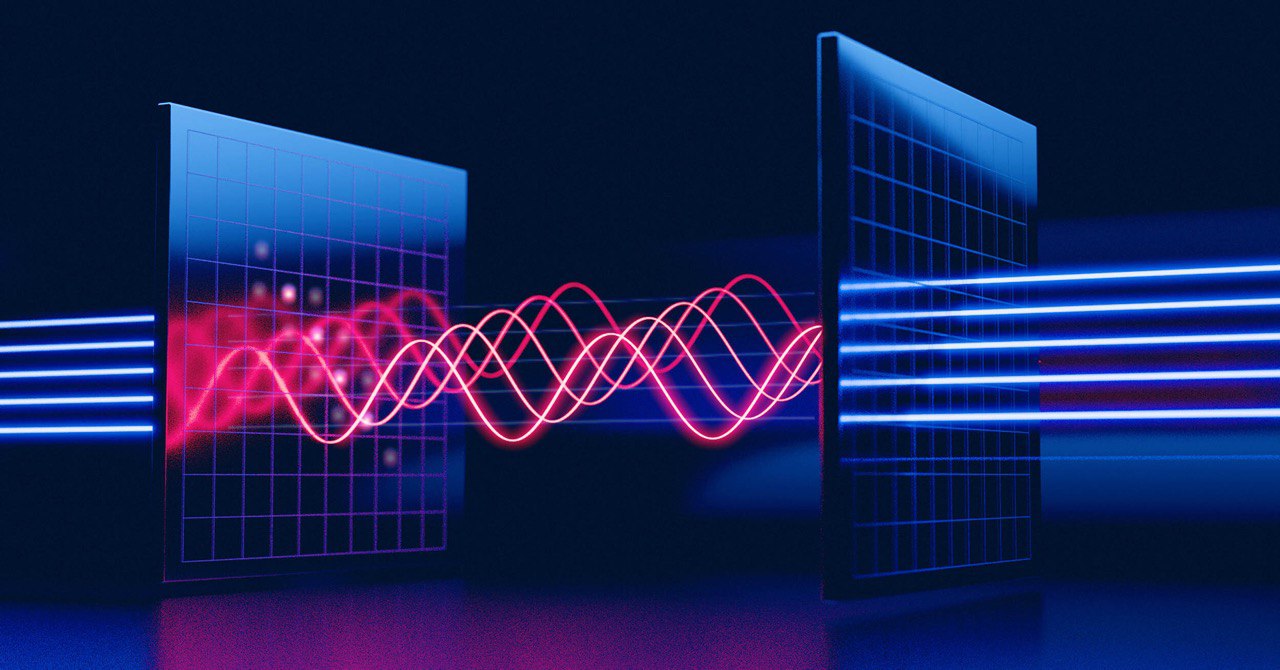
The resonator is divided into two paths. The memory loop contains a gain medium and imaging optics that map the optical field onto itself after each round trip. Above a threshold pump power, the gain compensates for cavity losses, and the laser oscillates. These dynamics act on the field amplitude and drive it toward a stable value. The phase of the field, however, remains completely unconstrained by the laser equations. As long as the amplitude stays above threshold, any phase value is equally valid. This loop does not perform any computation. It simply keeps the light alive.
The operator loop does the mathematics on the information that is encoded in the phase of the field. A beam splitter diverts a small fraction of the circulating field into a secondary path containing optical elements that implement the PDE time-step operator. A second beam splitter recombines this processed light with the main beam. The two fields interfere, and that interference nudges the phase of the circulating light forward in time.
The splitting ratio of these beam-splitters determines the step size: Send a larger fraction through the operator loop and the phase evolves faster but less smoothly; send less and convergence slows but becomes more stable. The crucial point is that the phase and amplitude dynamics separate. The memory loop stabilizes the amplitude, while the phase, freed from laser constraints, evolves under whatever mathematical operator is built into the operator path. Since each round trip takes only as long as light needs to traverse the cavity – a few nanoseconds – every iteration runs at constant time, independent of problem size or operator complexity.
The operator loop chains together standard optical components, each performing a specific mathematical task. Beam splitters and fixed optical elements handle the basics: addition and subtraction. These are the same components managing the split between the loops and may be used similarly within the operator path for arithmetic operations.
A Spatial Light Modulator (SLM)is a programmable optical element, containing millions of pixels, where each pixel can independently shift the phase and attenuate the amplitude of light passing through it. Passing through an SLM in the image plane encodes multiplication by a spatially varying pattern.
Even more powerful, however, is passing through the SLM in the Fourier plane. After passing through a lens, the field represents spatial frequencies rather than local values. Multiplying the field by a pattern in this Fourier plane is mathematically equivalent to convolving with a kernel in the image plane. With the right pattern programmed onto the Fourier-plane SLM, we can physically encode convolution operators, which naturally include differentiation operators such as the Laplacian operator that governs diffusion. While performing convolutions on CPUs and even on GPUs is very computationally expensive (i.e. time consuming), in the LPU the time is related only to the length of the cavity, regardless of the kernel complexity.
Enforcing boundary conditions means holding the field (or its spatial derivatives) steady, effectively ignoring the operator, at specific positions (the boundaries). One way of doing this is through a clever trick using a digital micromirror device (DMD). The DMD is used to inject an auxiliary laser beam exclusively at pixels corresponding to the domain boundary. Through carefully designed polarization optics, this injected light is isolated from the naturally evolving field. At boundary locations, the injected beam simply overwrites whatever phase developed through the PDE dynamics. The boundary values are pinned externally, while the interior field evolves freely to satisfy the differential equation.
Each round trip through the cavity is one iteration, and the phase profile evolves until the operator loop’s contribution vanishes. At that steady state, a camera reads out the phase distribution: the solution to the PDE. In principle, a very fast camera could be used to also measure the evolving dynamics of the PDE solution.
Importantly, the iteration time is set by cavity geometry, not problem parameters. A 100×100 grid and a 1000×1000 grid traverse the same optical path in the same few nanoseconds. The grid size is limited, practically, only by the quality of the optics; the fundamental physical cap then becomes the diffraction limit. Four-neighbor and hundred-neighbor convolutions take the same time per iteration. The computational bottleneck shifts from arithmetic and memory bandwidth to a single question: how many round trips does the physics require?
In future posts, we will examine which PDEs map onto this architecture and where optical solvers fit in the landscape of high-performance computing.

Sign up for updates
LightSolver Ltd., its parent company and its affiliates (“LightSolver”,“we”, “our” or “us”) respects the privacy of the users of its website at the address https://lightsolver.com/ (the“Site”) and is committed to the protection of the Personal Information (as defined below) that its Users share with it. We believe that you have a right to know our practices regarding the information we may collect and use when you visit or use our Site.
This Website Privacy Policy (this “Privacy Policy”) constitutes a binding and enforceable legal instrument between LightSolver and you – so please read it carefully. Capitalized terms that are used but not defined herein, as well as the terms “you” and “User,” shall have the meaning ascribed to them in our Website Terms of Use (“Terms of Use”), which incorporate the terms of this Privacy Policy by reference.
BY ENTERING, CONNECTING TO,ACCESSING AND/OR USING THE SITE, YOU AGREE TO THE TERMS AND CONDITIONS SET FORTH IN THIS PRIVACY POLICY, INCLUDING WITH RESPECT TO THE COLLECTION AND PROCESSING OF YOUR PERSONAL INFORMATION (AS DEFINED BELOW). IF YOU DISAGREE WITH ANY TERM PROVIDED HEREIN, YOU MAY NOT USE THE SITE.
a. The first type of information is non-identifiable and anonymous information (“Non-Personal Information”). We are not aware of the identity of the User from which we have collected Non-Personal Information. Non-Personal Information is any unconcealed information which is available to us while Users are using the Site. Non-Personal Information which is being gathered consists of technical and behavioral information, and may contain, among other things, the activity of the User on the Site, a User’s “click-stream”on the Site, etc.
b. The second type of information is information which identifies an individual, or may with reasonable effort identify an individual, either alone or in combination with other information (“Personal Information”). This information may identify you or be otherwise associated with you. The PersonalInformation that we gather consists of any personal details provided voluntarily by the User or on their behalf. The Personal Information required from the User while filling in the contact forms (including the “Login” feature, the “Support” options or use of the Site’s chat widget) may include the User’s full name, e-mail address, phone number, country, company, job title and ICCID (IntegratedCircuit Card Identification Number) and the User may also voluntarily provide other information in free text fields as part of a dedicated message to us.
For the avoidance of doubt, any Non-Personal Information connected or linked to any Personal Information shall be deemed Personal Information for as long as such connection or linkage exists. Under this Privacy Policy, the term “information” shall mean both Personal and Non-Personal Information.
We do not collect any PersonalInformation from you without your approval, which is obtained, inter alia, through your acceptance of the Terms of Use and this Privacy Policy.
We collect information via the following methods:
a. We automatically collect information through your use of the Site. As you navigate through and interact with our Site, we may use automatic data collection technologies (like browser cookies and flash cookies) to gather, collect and record certain information about your equipment, browsing actions, and patterns, including details of your visits to our Site and information about your computer and internet connection (such as your IP address, operating system, and browser type), either independently or through the help of third-party services, as detailed below.
b. We collect information which you provide us voluntarily and with your consent. For example, we collect Personal Information which you voluntarily provide when you fill different forms on the Site or contact us in any other way. We store the Personal Information either independently or through the help of our authorized third-party service providers, as detailed below.
c. We use third party software and services to collect information. Third parties may collect and process information such as usage analytics data in order to provide and operate the Site and improve our products and services.
a. We collect, process and use your information for the purposes described in this PrivacyPolicy, based at least on one of the following legal grounds:
i. With your consent: We ask for your consent, under this Privacy Policy, to process your information for specific purposes and you have the right to withdraw your consent at any time.
ii. When providing you with access to the Site: We collect and process your information in order to (i) provide you access to the Site; (ii) to maintain and improve our Site; (iii) to develop new services and features for our Users; (iv) and to personalize the Site in order for you to get a better user experience.
iii. Legitimate interests: We process your information for our legitimate interests while applying appropriate safeguards that protect your privacy. This means that we process your information for things like detecting, preventing, or otherwise addressing fraud, abuse, security, usability, functionality or technical issues with our services, protecting against harm to the rights, property or safety of our properties, or our users, or the public as required or permitted by law; enforcing legal claims, including investigation of potential violations of this PrivacyPolicy; in order to comply or fulfill our obligations under applicable laws, contractual requirements, legal process, subpoena or governmental request, as well as to enforce our Terms of Use.
b. Non-Personal Information and PersonalInformation are collected in order to:
i. to provide you with and to operate the Site, including for statistical and research purposes and creation of aggregated and/ or anonymous data;
ii. to develop, improve and customize the Site, the experience of other users and the offering available through the Site;
iii. to be able to contact you for the purpose of providing you with technical assistance, support, handle requests and complaints and collect feedback in connection with performance of the Site;
iv. to send you updates, notices, announcements, and additional information related to the Site
v. to be able to reply to your online queries in connection with performance of theSite;
vi. to display or send to you marketing and advertising material when you are using the Site, including in accordance with the section titled ‘Direct Marketing’ herein; and
vii. to comply with any governmental agencies’ legal requests or court orders, or with any applicable law, rule or regulation.
LightSolver may disclose Personal Information in the following cases: (a) to comply with any applicable law, regulation, legal process, subpoena or governmental request; (b) to enforce the Terms of Use (including this Privacy Policy) or any other agreements between you (or any persons affiliated with you) and us, including investigation of potential violations thereof; (c) to detect, prevent, or otherwise address fraud, security or technical issues; (d) to respond to your support requests; (e) to respond to claims that any content available on the Site violates the rights of third parties; (f) to respond to claims that contact information (e.g., name, e-mail address) of a third party has been posted or transmitted without their consent or as a form of harassment; (g) to protect the rights, property, or personal safety of LightSolver, its Users, or any other person;(h) in connection with a change in control of LightSolver, including by means of merger, acquisition or sale of all or substantially all of its assets; (i) to LightSolver’s third-party service providers that provide services to LightSolver to facilitate our operation of the Site or our services (e.g., Amazon Web Services); (j) for any other purpose disclosed by us when you provide the Personal Information; or (k)pursuant to your explicit approval prior to such disclosure. For avoidance of doubt, LightSolver may transfer and disclose Non-Personal Information to third parties in its sole discretion.
Except as otherwise stated in this Privacy Policy, we do not sell, trade, share, or rent your Personal Information collected from our services to third parties. We may however transfer, share or otherwise use anonymized, aggregated or non-personal information in our sole discretion and without the need for further approval. You expressly consent to the sharing of your Personal Information as described in this Privacy Policy.
We retain the Personal Information we collect only for as long as needed in order to provide you with our services and to comply with applicable laws and regulations. We then either delete from our systems or anonymize it without further notice to you. If for any reason you wish to request a modification to, or deletion of, your Personal Information in accordance with Section 13 of this Privacy Policy, you may do so by contacting LightSolver at support@lightsolver.com or through the Site.
However, please note that, although your Personal Information may be removed from our systems, LightSolver will retain any anonymous information contained therein or any anonymized or aggregate data derived therefrom, and such information will be owned by us and may continue to be used by us for any purpose, including the operation or improvement of our services.
To use the Site, you must be over the age of seventeen (17). Therefore, LightSolver does not knowingly collect Personal Information from persons under the age of seventeen (17) and does not wish to do so. We reserve the right to request proof of age at any stage so that we can verify that persons under the age of seventeen (17) are not using the Site.
We take a great care in implementing and maintaining the security of LightSolver’s Site and its User’s PersonalInformation. LightSolver employs industry-standard procedures and policies to ensure the safety of its Users’ Personal Information and prevent unauthorized access to or use of any such information. However, we do not and cannot guarantee that unauthorized access or use will never occur.
In order to provide and operate the Site, we use third-party software and services to collect and process the information detailed herein, and to improve our products and services. Examples include: web hosting, sending communications, analyzing data and conducting customer relationship management. These third-party service providers have access to the information needed to perform their respective functions, but may not use it for other purposes unless such data has been first anonymized. Further, they must process that information in accordance with this Privacy Policy and as permitted by applicable law.
LightSolver may use industry-standard technologies, such as “cookies” or similar technologies, which store certain information about you on your computer and allow us to enable the automatic activation or personalization of certain features, there by making your interactions with us more convenient and efficient. The cookies that we use are created per session and do not include any information about you, other than your session key (which is generally removed at the end of your session). Most browsers will allow you to easily erase cookies from your computer’s hard drive, block acceptance of cookies, or receive a warning before a cookie is stored. However, if you block or erase cookies, your online experience and our ability to provide the Services to your Advisor may be limited or degraded. We do not respond to do-not-track signals.
Information regarding theUsers will be maintained, processed and stored by us and our authorized affiliates and service providers in the United States and, as necessary, in secured cloud storage provided by our third-party service provider(s), which may include facilities located outside of the aforementioned location. You hereby accept the place of storage and the transfer of information as described above.
LightSolver welcomes all qualified candidates(“Candidates”) to apply to any of the open positions posted on our Site or otherwise (including without limitation – Facebook and LinkedIn) by sending us their contact details and resumes(“Candidate Information”). We are committed to keep CandidateInformation private and use it solely for our internal recruitment purposes(including for identifying Candidates, evaluating their applications, making hiring and employment decisions, and contacting Candidates by phone or in writing).
Please note that we may retain Candidate Information submitted to us even after the applied position has been filled or closed. This is done so we may re-consider Candidates for other positions and opportunities at LightSolver; so we may use such CandidateInformation as reference for future applications; and in case the Candidate is hired, for additional employment and business purposes related to their employment or engagement with LightSolver.
If you previously submitted your Candidate Information to LightSolver and now wish to access it, update it or have it deleted from our systems, please contact us at: support@lightsolver.com.
If the law applicable to you grants you such rights, you may ask to access, correct, or delete your Personal Information that is stored in our systems. You may also ask for our confirmation as to whether or not we process your Personal Information.
Subject to the limitations in law, you may request that we update, correct, or delete inaccurate or outdated information. You may also request that we suspend the use of anyPersonal Information whose accuracy you contest while we verify the status of that information.
Subject the limitations in law, you may also be entitled to obtain the Personal Information you directly provided us (i.e., excluding data we obtained from other sources) in a structured, commonly used, and machine-readable format and may have the right to transmit such data to another party.
If you wish to exercise any of these rights, contact us at: support@lightsolver.com. When handling these requests, we may ask for additional information to confirm your identity and your request. Please note, upon request to delete yourPersonal Information, we may retain such data, in whole or in part, to comply with any applicable rule or regulation, and/or to respond to or defend against legal proceedings.
To find out whether these rights apply to you and on any other privacy related matter, you can contact your local data protection authority if you have concerns regarding your rights under local law.
You hereby agree that we may use your contact details provided during registration or otherwise volunteered through the Site for the purpose of informing you regarding our products and services, the Site and other news which may interest you, and to send to you other marketing material about related products and services offered by LightSolver. You may withdraw your consent by sending a written notice to LightSolver by email to the following address: legal@LightSolver.io or by pressing the “Unsubscribe” button in the email.
The terms of this PrivacyPolicy will govern your interaction with us and your use of the Site and any information collected in connection therewith. LightSolver may change thisPrivacy Policy from time to time, in our sole discretion and without any notice. LightSolver will notify you regarding material changes of the terms of this Privacy Policy by notice on the Site or by sending you an e-mail regarding such changes to the e-mail address that you provided in the registration form. Such material changes will take effect seven (7) days after such notice is provided on our Site or sent by email. Otherwise, Changes to this Privacy Policy are effective as of the stated “Last Updated” date and your continued use of the Site after the “Last Updated” date will constitute your acceptance of, and agreement to be bound by, such changes. You are responsible for periodically visiting our Site and this Privacy Policy to check for any changes. IF YOU DO NOT AGREE WITH CHANGES TO THE TERMS OF THIS PRIVACY POLICY, YOU ARE OBLIGATED TO PROMPTLY NOTIFY US AND TERMINATE YOUR USE OF THE SITE.
If you have any questions (or comments) concerning this Privacy Policy, you are welcome to send us an email at the following address: support@lightsolver.com.